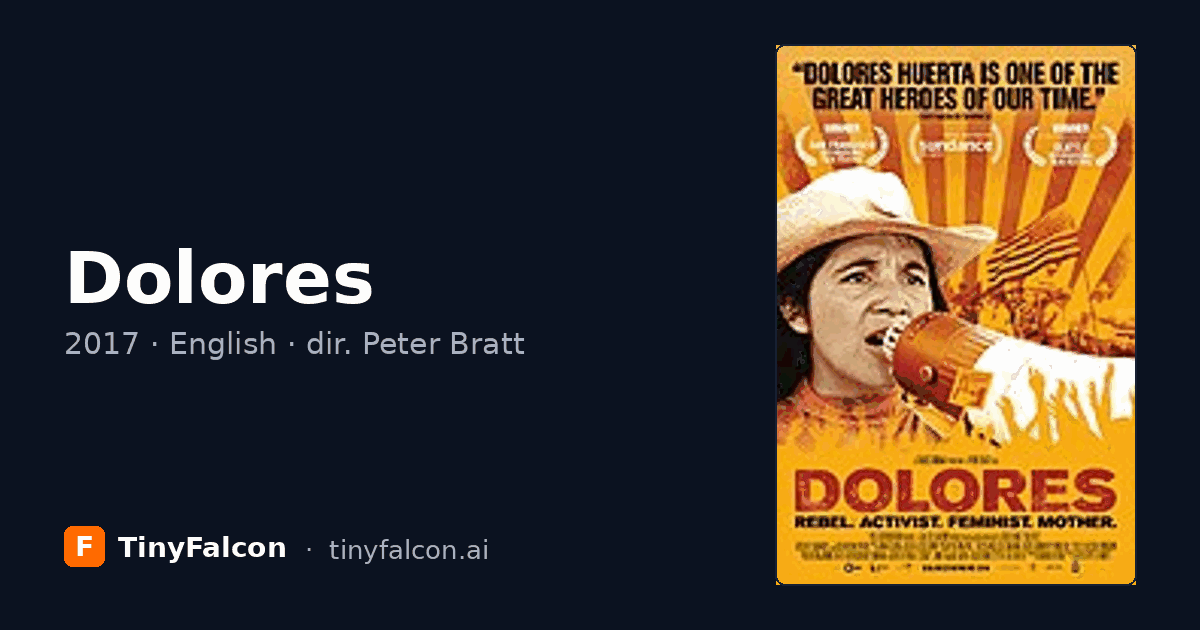
| Director | Peter Bratt |
|---|---|
| Genre | documentary film |
| Runtime | 95 min |
| Country | United States |
The documentary begins discussing Dolores' life prior to her becoming the activist she is known for being today. Dolores during the 1940s and 50's was living out the typical life of a Chicano for that period. Even at an early age she was disturbed by the world around her, and felt unsatisfied with the life that she was living. She witnessed police brutality and other horrors that made her feel that there was not true justice or equality in the world she was living in. In addition, she was unsatisfied with her life as a young mother. Having been married and divorced twice she was looking for something to fulfill her and this is when she met Fred Ross.
Fred Ross was community organizer in California who was searching for individuals who were willing to make the community better. His goals were immediately attractive to young Huerta because of Ross' focus on police brutality, and his efforts to combat it. Their relationship blossomed and by 1959 Dolores was head of the Stockton Chapter of the Community Service Organization, a group dedicated to helping Latino individuals in the community.
During this time period Dolores proved to be a great leader, organizer and lobbyist. She would pack hundreds of people into the office of legislators until they came around to supporting legislation she wanted. In addition, it was during these early years that she was introduced, by Ross, to Cesar Chavez. Chavez had the goal of organizing a union for farm workers and knew Dolores was going to be the person he needed to help him achieve this goal. Between the efforts of both Huerta and Chavez the United Farm Workers of America was born. The documentary discusses the extensive commitment Dolores made when starting up this organization. She was forced to pick up and move her family to Delano, California in order to be connected to the agricultural communities she was trying to help. She was forced to even leave some of her younger children behind for fear they would not be able to endure the circumstances of their new living conditions and mothers dedication to the UFW. She sacrificed a lot during the early years even some of the things she enjoyed the most, like listening to jazz music.
While UFW had made great strides in the relations of farm workers and farm owners the Filipino workers going on strike. It was then that Huerta and Chavez realized that they needed more inclusion in their organization. Not just Latino's were facing these horrible working conditions. As the UFW started to include more groups of workers they also started to recruit more and more individuals to work for them. In fact, there were more women involved in the UFW than in any other union in the United States combined. The following year, 1966, the UFW saw its first major success following the March to Sacramento. The march from Delano to Sacramento California was the largest gathering of farmworkers in California history. As a result of the march, the Schenley Contract was negotiated. This contract was the first between farm workers and growers.
During Robert F. Kennedy's run for president he became a huge supporter of the UFW and disenfranchised groups as a whole. As a senator he stood with the movement in regards to their treatment during the strikes. He actively went after the corporations who were mistreating the farmworkers. Due to his support of the UFW, the UFW fully supported his presidential run. Everyone went and worked on his campaign. UFW members would knock on doors persuading people to vote and even registering them to vote.
The relationship between Senator Kennedy and Dolores was so strong that she was actually with him the night of his assassination. This event was very jarring for Dolores and the rest of the UFW because they felt that the one person who would actually stand up for them was gone. In addition, his assassination made Dolores even more passionate about non-violence in her movement.
By 1973 the UFW had successfully organized three year contracts in California, Arizona, New Mexico and Texas. As the contracts were about to expire the UFW started to experience problems with the teamsters. They wanted to represent all of the people formerly represented by the UFW. They were ultimately successful in a lot of their efforts. As a result, the UFW went on strikes and boycotts that often turned extremely violent so even resulting in death. This was all particularly upsetting for Dolores because it became clear to her that the current system did not want "brown people" to have an organization or have power.
In 1988, George Bush was holding a fundraiser in California. Many members of the UFW, including Dolores went and were peacefully protesting outside the building. As the crowd grew larger, crowd control officers began pushing and yelling at the protestors to move back. Dolores was following their orders when suddenly one of the officers started to hit and bash her with a police baton. She was hospitalized with three broken ribs as well as had to undergo emergency spleen removal. The beating resulted in a very long hospitalization and Dolores was weak for many many months. She had to take a long absence from the movement she had worked so passionately for many years.
In 1993, Chavez was found dead of natural causes in Arizona. His death was extremely upsetting to Dolores as well as the rest of the UFW. While many members and the public wanted to see Dolores as the new president, considering how equally she and Chavez had worked for decades, however the board voted to appoint someone else. Following this decision it was clear that others did not value the opinion of Dolores as Chavez had at that her voice in the UFW was slowly shrinking.