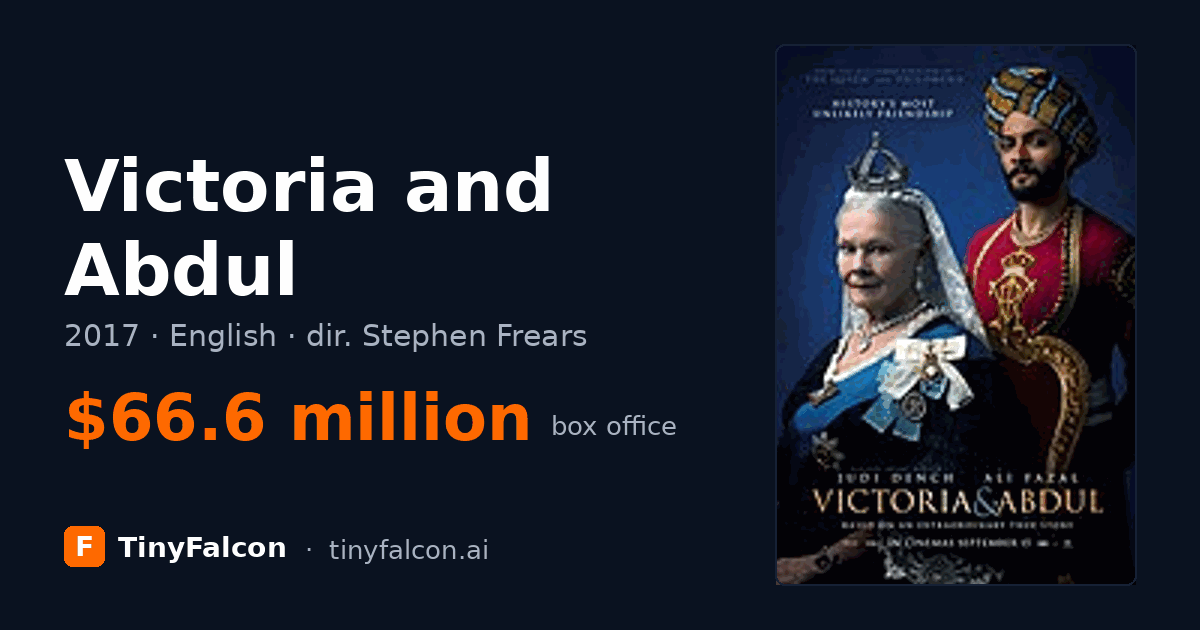
| Director | Stephen Frears |
|---|---|
| Genre | biographical film, drama film, historical film |
| Runtime | 112 min |
| Country | United Kingdom, United States |
| Budget | $21 million |
| Box office | $66.6 million |
Abdul Karim, a young prison clerk from a Muslim, Urdu-speaking family in Agra, British India, is instructed to travel to Britain for Queen Victoria's Golden Jubilee in 1888 to present her with a mohur, a gold coin that has been minted as a token of appreciation from British-ruled India.
The Queen, lonely and tired of her fawning courtiers, develops an interest in and then a friendship with Abdul. She spends time with him alone and gives him a bejewelled locket with her photograph. She promotes him to be her Munshi and asks him to teach her Urdu and the Quran. She in fact learns Urdu for 14 years. When Victoria discovers he is married, she has him bring his wife to England. His wife and his mother-in-law both wear black burqas, much to the consternation of the household—and the fascination of Victoria.
As Victoria's interest in India grows, she has the Durbar Room built at her Isle of Wight home of Osborne House for state functions. It is elaborately and intricately decorated, with a carpet from Agra, formal portraits of renowned Indians, a replica of the Peacock Throne and carvings by Bhai Ram Singh.
While Victoria treats Abdul as a son, his preferment is resented by her household and inner circle, including her son, Bertie, and the prime minister, Lord Salisbury. The household plots to undermine their relationship, hoping that Abdul will be sent home. When Victoria embarrasses herself by recounting Abdul's one-sided account of the Indian Rebellion of 1857 to the court, Victoria's faith and trust in him are shaken. She decides he must return to India, but soon changes her mind and asks him to stay.
The prime minister is adamant that the royal household must be rid of Abdul. They research his family background in India and present Victoria with a dossier showing that his family is more ordinary and poor than Abdul claimed. When Victoria insists that her doctor examine Abdul to learn why his wife has not become pregnant, he discovers that Abdul has gonorrhea. He expects the Queen will dismiss Abdul in disgust, but Victoria remains loyal to him, orders his medical treatment and admonishes her courtiers for plotting against him. She announces her intention to give Abdul a knighthood.
Eventually, the household decides that Victoria must break with Abdul. If not, they all will resign and have Victoria declared insane. When Victoria is told, she angrily summons her family and the entire household and demands that anyone who wishes to give up their place should step forward. When no-one does, she says she has decided against making Abdul a knight. She will instead include him in her next honours list as a Commander of the Royal Victorian Order.
When Victoria falls ill, she urges Abdul to return to India while she can still protect him and warns him that the court will turn on him after her death. Abdul insists that he will stay until her death. In 1901, Victoria dies, and Bertie, now King Edward VII, rejects Abdul, burning all the gifts and papers from the Queen, and sending him and his family back to India. Abdul's wife saves the locket Victoria gave him.
It is revealed that Abdul lived in India until his death eight years later in 1909. The film ends with Abdul bowing out to a large statue of Queen Victoria close to the Taj Mahal, and talking to it in respect.