| Director | Juraj Herz |
|---|---|
| Budget | $3.2 million |
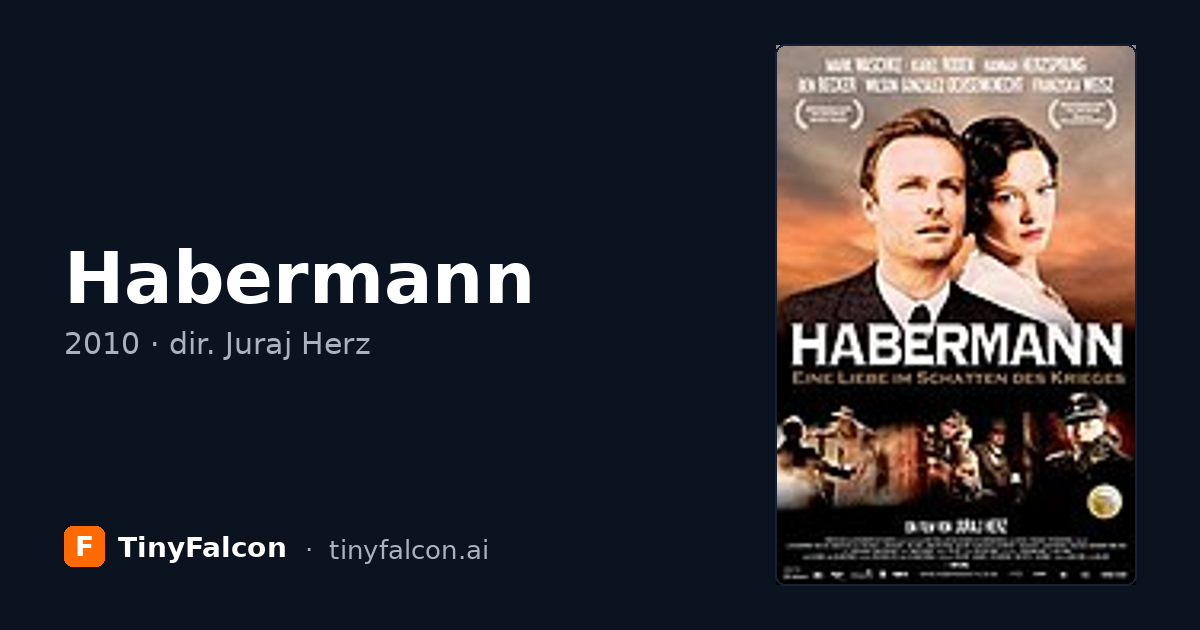
In 1937, August Habermann is a wealthy ethnic German owner of a local mill that serves as both a sawmill and gristmill in the town of Eglau in the Sudetenland. Habermann employs both Sudeten Germans and Czechs and believes that the two peoples should co-exist peacefully. Habermann is apolitical and marries a Czech woman, Jana, whom he later learns is half-Jewish. Habermann's best friend, Karel Březina, is Czech. In October 1938, after the Munich Agreement, the Sudetenland is transferred to Germany. Habermann welcomes the change as it gives his firm access to the German market, but Karel warns him that he and all the other Czechs in the Sudetenland are now second-class citizens. Karel's warning is soon confirmed by the arrival of the brutal SS Sturmbannführer Kurt Koslowski, who mistreats the local Czechs. Koslowski takes a bullying tone toward August, forcing him to sell flour from the mill to a local hospital/spa that treats wounded German soldiers at cost. August is shocked by the way Koslowski beats his Czech employees. August is especially protective of one of his Czech employees, Masek, the son of his housekeeper Eliška, who is later revealed to be his half-brother as Eliška was his father's mistress.
Over the opposition of August, his ardently Nazi younger brother Hans joins the Wehrmacht in 1941 after graduating from the Hitler Youth. In 1943, pamphlets appear predicting Germany's defeat, leading Koslowski to kill Hora, the Czech bookkeeper at the mill. Hans is badly wounded in 1944, and Jana takes him off a train, making him into a deserter. Hans wants to return to the war, but Jana and August both tell him that he has suffered enough for "that madman". While traveling with Karel down a forest road Masek kills a German soldier he meets, forcing Karel to kill another soldier to silence a witness. Koslowski decides to execute 20 Czechs selected at random in retaliation, leading August to bribe him with his family's expensive jewelry to stop the executions. Koslowski breaks his word and executes nine Czechs he had chosen at random while sending Jana and her daughter to a concentration camp. Hartel, the collaborating Mayor of Eglau, tells Koslowski that Jana's father was Jewish. August is broken in spirit, and he ignores Karel's advice to flee the Sudetenland, saying that this is his home where his family has lived for centuries and he is already spiritually dead as he believes that his wife and daughter are dead.
After Czechoslovakia is liberated in May 1945, a lynch mob atmosphere prevails as the Czechs attack the Sudeten Germans; the Sudeten Germans are forced onto a train bound for occupied Germany by the Czechoslovak Army. Jana together with her daughter escape from the concentration camp and are helped on their way home by Red Army soldiers who are advancing into the Sudetenland. Eliška loots the Habermann family safe and tells Masek that his father was Wilhelm Habermann, making this not theft, but rather giving him his rightful inheritance. Masek boasts to a vengeful Czech mob led by mayor Hartel that he is a Habermann and as such, he is now the owner of the Habermann mill, leading to Hartel and the others to lynch him as a traitor. August is killed by the same lynch mob led by Hartel who tie him to the water wheel of his mill. Jana together with her daughter are expelled from the Sudetenland. As she is forced onto a train that will take her and her daughter to Bavaria, Karel hands her a piece of jewelry that was given to her by August on their wedding day, saying that this is a way to keep his memory alive. The film's epilogue states in reality the forester Karel Březina accused the mayor of leading the mob that lynched the real Hubert Habermann, the owner of a mill in the Sudetenland, but none were ever prosecuted for the crime.